E welina mai ka mea haʻi moʻolelo!
Welcome storyteller…
Resources for writers and readers of Hawaiian fiction!
Orgs to know
Writing advice
Q&A
Resources
✳︎
Nonprofits
✳︎
Mentorship
✳︎
Writing Programs
✳︎
Resources ✳︎ Nonprofits ✳︎ Mentorship ✳︎ Writing Programs ✳︎

Pacific Islanders in Publishing
A directory of Pacific Islander books, authors, and other publishing professional. The Discord link (top right corner) also helps to connect members to each other to form community. Membership is open to anyone at all levels and is completely free. Please join us to talk books, writing, ask for advice, find critique partners and more.
PEAK Pasifika
A network for Pasifika creatives in film and tv that offers training and developmental opportunities including the Writers Fellowship and the Producer & Executive Fellowship, both of which are free. You do not need to be Pacific Islander to apply.
Native Hawaiian Philanthropy
A nonprofit with the focus of helping to build the Hawaiian storytellers of tomorrow, offering free programs for Hawaiian Storytelling, Music Video Production (Maui), AI Grant Writing App & Training, all of which are free.
The Black List
A free platform for writers and screenwriters to showcase their projects for industry professionals and get high-quality evaluations from vetted readers. There is a fee to receive an evaluation. The program offers various writing contests, labs, and programs throughout the year including Writing Labs for screenwriters, and the annual Unpublished Novel Award. Some of the contests include cash rewards.
We Need Diverse Books
A nonprofit dedicated to serving marginalized creators, publishing workers, educators, and readers that’s focused on Children’s and YA markets. They offer free programs for Mentorship and Writing programs such as the Native Writing Intensive and the Revisions Workshop.
Write Hive
A 100% free annual writing workshop conducted virtually that offers other free writing craft opportunities that seeks to provide safe, inclusive, and free resources for all writers.
NDN Girls Book Club
A nonprofit that hosts free literary workshops for Native people, especially Native youth and girls. Offers resources for writers and readers and educational materials.
ʻŌiwi Book Club
A virtual and in-person book club (Maui) that centers Native Hawaiian voices. They read books by Native Hawaiian authors and Hawaiʻi-based stories across fiction, nonfiction, memoir, history, culture, and contemporary literature to create a welcoming space where readers can connect through stories rooted in Hawaiʻi while supporting Native Hawaiian authors and storytelling.
Scroll down for Q&A and advice for readers and writers.
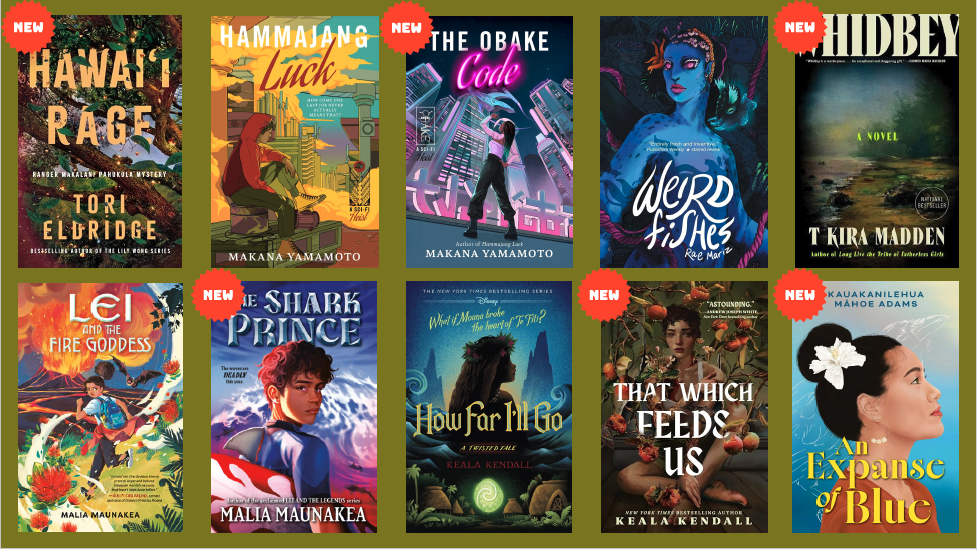
Reader Q&A
How do I find books by Hawaiian authors?
1
The best resource right now is Pacific Islanders in Publishing which keeps a directory. Books can be found in any genre and from authors across the Pacific in Melanesia, Micronesia, and Polynesia.
How do we become ARC (Advanced Copy) readers for Hawaiian authors?
2
The best way to get on an early ARC list for an author is to join their author newsletter. Most authors will have a sign up for this on their professional website. The other way is to follow them on social media, with Instagram being the most used site for authors. Many will post when searching for ARC readers.
Another great option is to ensure you have a NetGalley account, so that you can request ARC copies the moment they are released by a publisher.
You can sign up for Shay’s Newsletter here or follow her on Instagram here.
How do we get more Hawaiian books? / How do we best support Hawaiian authors?
3
The best way to support Hawaiian books and authors is to read our stories!
Encourage others to buy our books
Ask your local library or indie bookstore to carry a copy
Leave an honest review on Goodreads, Amazon, a personal blog, or wherever else you can
Use your social media to promote the books you love
Publishers look to see what readers respond to, so the more vocal support there is to Hawaiian works, the more they will seek out these stories.
How do I find a community of other readers?
4
There are more and more opportunities to connect with other readers than ever before.
ʻŌiwi Book Club is run by a kanaka maoli writer on Maui that offers opportunities to meet both in person and virtually; follow them on instagram here
Pacific Islanders in Publishing welcomes readers to join the discord to discuss and share their current reads; follow them on instagram here
Writer Q&A
Please know that this advice is specifically geared towards writers who are interested in traditional publishing. Self-publication is a rewarding process that has an entirely different set of steps.
Still have questions? Click the buttons below to learn more about Shay’s thoughts on cultural specific issues in regards to publishing and writing.
-
Publishing has a variety of careers open to folks who are interested:
Agent
Editor
Marketer
Publicist
Audiobook Narrator (Voice Actor)
Sensitivity Reader
Content Specialist
Cover Designer
Illustrator, etc.
-
The best way to improve your writing is to write! Join a local writing group or find a critique partner, a person who writes in your genre of a similar level to you, so you can swap pages and give each other feedback.
Craft is also important, and listening to lectures like Brandon Sanderson’s free series on YouTube is great, but remember to also apply what you learn to your writing. I still think, though, that writing is the key. Most people’s first book is bad. (Mine was!) So keep at it!
-
Finish your manuscript! This is so important and is the only thing that will kick off your writing journey. Secondly, take yourself seriously as a writer. Give yourself time to write, and invest in yourself whatever that means to you.
Start a social media account to document your writing (That’s actually what I did)! Join writing groups! Make sure you write at least 15 minutes a day! Pick a few things to try and stick with it. Consistency and practice will always pay off far more than “natural talent.”
-
Publishing a book is a long process. Be ready to put in years of work because there is no shortcut to making a book.
Also, it’s important to be mentally ready to receive feedback and critique. Don’t fear this! Critique is how you improve and you’ll need to develop a muscle to not take it too personally, and to sort between which pieces of advice you’re going to take and which you’re going to discard.
You’ll likely have to rewrite your book many many times before it is ready to be published, so buckle up! It’s a fun and wild ride!
-
The biggest differences between self-publishing and traditional publishing are in three areas: money, distribution, and control. The advance that you’ll get through traditional publishing is a guaranteed form of payment for your work. With self-publishing, that’s not possible. The money you make from self-publishing will depend entirely on your sales and are not guaranteed.
Distribution is another major factor as traditional publishing will ensure your book is sold in stores across the country. Self-published books may struggle to get a bookstore to carry physical copies of their book on shelves.
Control is another big aspect of the publishing process. Self-published authors are responsible for everything and must design covers, do marketing, publicity, etc. on their own. The trade off is that they get to be the final decision makers on all of those choices. Traditional publishing takes a lot of that off your plate (except social media!), but in exchange, you may have less input on things like cover design or title. The best choice is really whatever is most important for you as a writer.
-
This depends on your larger goals and the genre that you are writing in. In my experience, there are a lot of literary writers who hold MFAs and these tend to help them a lot. For genre writers, an MFA might not be as helpful. As someone who writes speculative fiction (science fiction, fantasy, horror) most MFA programs were not going to provide me with what I needed as a writer.
I’ve found major conferences and genre-specific writing workshops to be incredibly worth it, but you should never go into debt to attend them. Take advantage of scholarship opportunities, fundraising, and other means of financing these activities rather than paying out of pocket for everything. It is also wise to pace yourself and be selective with what you can do and in what year.
-
For speculative fiction writers, here are the ones I’d recommend:
*I have personally attended ones indicated with an asterisk.
Conferences:
*WorldCon - HUGE! With panels on everything you can think of. A great opportunity to meet other writers.
Locus Magazine has a list of conventions updated yearly for smaller, regional cons.
Writing Workshops
*Odyssey Writing Workshop - The single best workshop I’ve ever done to improve craft. Very intense. Virtual option and scholarships available.
*Viable Paradise - One week and located in Martha’s Vineyard. Scholarships available but determined through lottery. (Will update after I attend.)
*The McCormick Writing Center - (Formerly TinHouse) A classic Milford Style Critique group with great mentors. Virtual option and scholarships available. Great opportunity to meet like-minded writers.
-
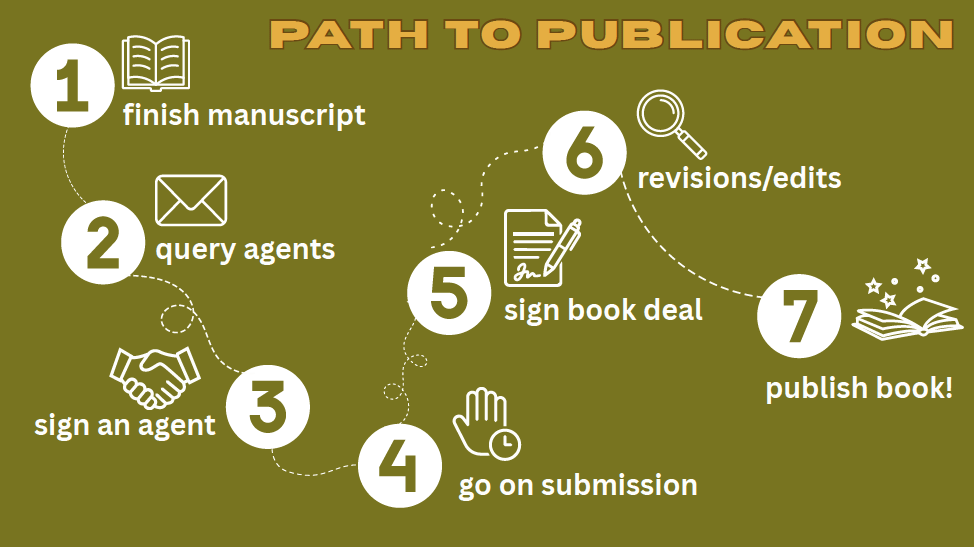
(View the visual map below and follow along with the listed steps here!)
1. Finish Your Manuscript
Before pursuing traditional publication, your manuscript should be complete and polished. For fiction writers, agents almost always expect a finished manuscript before considering representation.
2. Query Literary Agents
Querying is the process of sending submission materials to literary agents who may be interested in representing your work.
A typical query package includes:
A query letter
A synopsis
Sample pages or chapters (the amount varies by agent)
Each agent has different submission requirements, so read their guidelines carefully before submitting. Agents also specialize in specific genres, age categories, and markets, so only query agents who represent books similar to yours.
You may only submit to agents who are currently open to queries. If an agent is closed to queries, they are not accepting submissions at that time.
Useful resources:
Manuscript Wish List – Learn what agents and editors are actively seeking.
Bluesky – Many agents share wish lists, submission updates, and industry advice.
QueryTracker – Research agents and submit queries when applicable.
Additional guides:
3. Sign with an Agent
If an agent offers representation and you accept, you will enter into an agreement for them to represent your work.
Literary agents are typically paid a percentage of the money they negotiate for you in your advance. If they do not sell your manuscript, they do not get paid.
You should never pay an agent upfront to represent your work. Reputable literary agents earn their income through commissions, not fees.
4. Go on Submission
Once your manuscript is ready, your agent will submit it to acquiring editors at publishing houses. This stage is commonly referred to as being "on submission" or simply "on sub."
Your agent will identify publishers that may be a good fit for your book and pitch your manuscript to them.
5. Receive a Book Deal
If an editor at a publishing house likes your book, they will need approval from the publisher. This step is called “acquisitions.” If the publisher decides to acquire your manuscript, they will make an offer. If you accept the offer and sign the contract, you will have a book deal.
Most traditional publishing contracts include an advance, which is money paid to the author before publication. The amount varies widely depending on the publisher, the project, and market conditions.
6. Editing and Copyediting
After acquisition, you will work with an editor at the publishing house.
The editorial process often includes:
Developmental or substantive edits (plot, pacing, character development, structure)
Line edits (clarity, style, and sentence-level improvements)
Copyedits (grammar, spelling, consistency, fact-checking, and formatting)
You may go through multiple rounds of revision before the manuscript is finalized.
7. Publication Day
Your publisher will assign a publication date and coordinate production, marketing, publicity, distribution, and sales efforts leading up to release.
On publication day, your book officially becomes available to readers through bookstores, libraries, online retailers, and other distribution channels.
Congratulations! You are a published author. Your book is now out in the world and available for readers to discover!